Address
304 North Cardinal
St. Dorchester Center, MA 02124
Work Hours
Monday to Friday: 7AM - 7PM
Weekend: 10AM - 5PM
Address
304 North Cardinal
St. Dorchester Center, MA 02124
Work Hours
Monday to Friday: 7AM - 7PM
Weekend: 10AM - 5PM
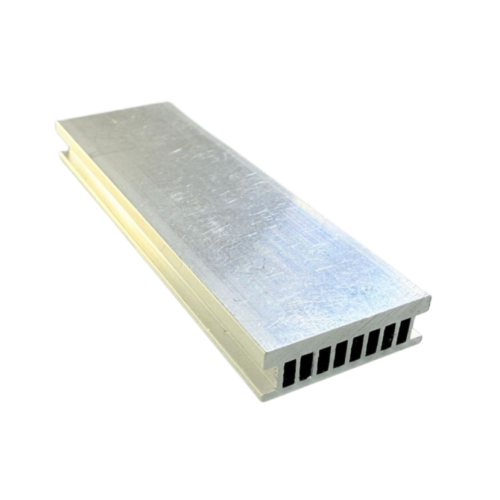
As data rates soar to 800G and beyond, the thermal density inside optical modules has reached a critical point. Traditional air-cooling fins are no longer sufficient to manage the heat generated by DSP chips and high-power lasers in compact form factors like QSFP-DD and OSFP. Overheating leads to bit errors, wavelength drift, and premature failure.
Our aluminum water-cooled heat sink for optics is specifically engineered to address this challenge. By leveraging the high specific heat capacity of liquid coolant, our cold plates provide superior thermal management, allowing your optical modules to operate at peak performance without throttling.
As data rates soar to 800G and beyond, the thermal density inside optical modules has reached a critical point. Traditional air-cooling fins are no longer sufficient to manage the heat generated by DSP chips and high-power lasers in compact form factors like QSFP-DD and OSFP. Overheating leads to bit errors, wavelength drift, and premature failure.
Our aluminum water-cooled heat sink for optics is specifically engineered to address this challenge. By leveraging the high specific heat capacity of liquid coolant, our cold plates provide superior thermal management, allowing your optical modules to operate at peak performance without throttling.
The shift from passive/air cooling to liquid cooling is driven by the relentless demand for bandwidth.
Ultra-Low Thermal Resistance: Liquid cooling achieves significantly lower thermal resistance than air cooling, effectively removing heat flux from high-power DSPs and laser drivers that generate >20W of heat in a confined space .
Ideal for High-Density Environments: In data center architectures where optical modules are densely packed, airflow is restricted. Liquid cooling bypasses this limitation, providing direct cooling at the heat source .
Temperature Stability for Precision Optics: Maintaining a stable case temperature is critical for wavelength control in DWDM and coherent optics. Our liquid cooling plates minimize temperature fluctuations, ensuring signal integrity .
Designed for the specific mechanical and thermal requirements of pluggable modules and silicon photonics.
Precision-Machined Module Interface:
The mounting surface is machined to ultra-tight flatness and roughness tolerances to maximize contact with the optical module’s housing. This minimizes interface resistance and ensures efficient heat transfer into the coolant .
Optimized Internal Channel Design:
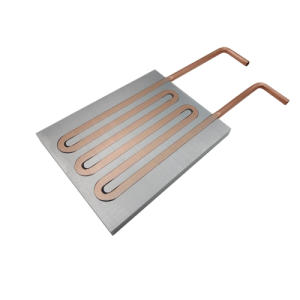
Utilizing advanced fluid dynamics simulation, our internal coolant channels are designed to maximize turbulence and heat exchange while minimizing pressure drop. We offer both straight-through channels and pin-fin structures for high-heat-flux hotspots.
Compact & Low-Profile Design:
Designed to integrate seamlessly into optical line cards and test equipment. Our cold plates are engineered to fit within the tight mechanical envelopes defined by MSA (Multi-Source Agreement) standards .
Corrosion-Resistant Materials:
Constructed from high-quality aluminum alloys with a protective coating to prevent galvanic corrosion when used with standard water-glycol coolants. Stainless steel fittings ensure leak-proof connectivity .
Custom Port Configurations:
Available with various barb, compression, or threaded fittings (e.g., G1/4, NPT) to suit your facility’s coolant distribution manifold.
Below are the typical specifications for our optical module liquid cold plates. Custom sizes and channel layouts are available for specific module types.
| Specification | Details |
|---|---|
| Material | Aluminum 6061 / 6063 (Copper base options available for extreme heat flux) |
| Surface Finish | Plain / Electroless Nickel Plating (Anti-corrosion) / Black Anodized |
| Coolant Types | Water, Water/Glycol Mixtures, Dielectric Fluids |
| Thermal Performance | Thermal Resistance as low as 0.02°C/W (depending on flow rate & design) |
| Pressure Drop | Optimized for standard rack cooling loop pressures |
| Leak Test | 100% Pressure Tested (e.g., 1.0 MPa) |
| Compatibility | QSFP-DD, OSFP, CFP2/4/8, Custom Silicon Photonics Packages |
Our aluminum water-cooled heat sinks are critical for next-generation optical applications:
Hyperscale Data Centers: Enabling 400G/800G pluggable modules to run at full power without thermal shutdown, supporting the bandwidth demands of AI/ML clusters and high-frequency trading.
Coherent Transmission Modules: Cooling high-power EDFAs and coherent DSPs used in long-haul and metro networks, ensuring wavelength stability for dense wavelength division multiplexing .
Optical Test & Measurement Equipment: Maintaining precise temperature control in laser sources and analyzers to ensure measurement accuracy and repeatability.
High-Power Pump Lasers: Cooling fiber laser pump combiners and modules where waste heat must be efficiently removed to protect the laser cavity.
Thermal Simulation Expertise: We provide CFD and FEA simulation services to model heat transfer and fluid dynamics specific to your module’s power map.
Rapid Prototyping: Need a custom shape for a prototype line card? We offer quick-turn machining to match your exact PCB layout and module cage positions .
Quality & Reliability: Every unit undergoes rigorous pressure and leak testing to ensure fail-safe operation in mission-critical optical networks.
Don’t let thermal limits constrain your bandwidth. Contact us today to discuss your optical module requirements and discover how our liquid cooling solutions can help you achieve reliable, high-speed performance.
[Request a Custom Quote] [Contact Engineering Team]

Reviews
There are no reviews yet.